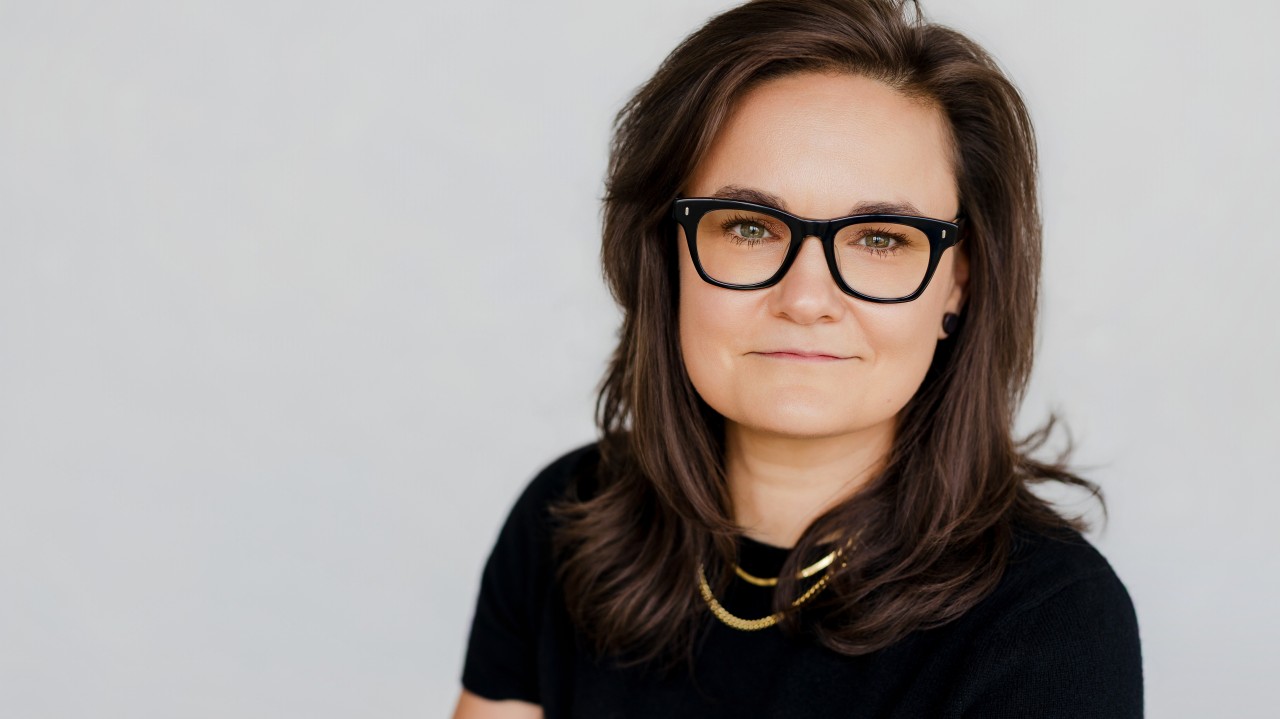
It had been nearly ten years since I had professional headshots taken, that is a very long time when I think about everything that has happened in between. In that decade, my career changed shape several times. I moved closer and closer to work that felt like mine, then closer still, until I was offered the opportunity to lead Slalom 's OpenAI partnership team, doing the kind of work that asks almost everything of me and gives almost everything back. I am stretched by it, energized by it, occasionally humbled by it, and more certain than I have been in a long time that I am standing in the right place at the right moment.
I wanted to remember that feeling. Not simply the title, or the job, or the outward facts of the season, but the interior weather of it: the momentum, the pride, the sense that I had arrived somewhere I had worked very hard to reach and was only just beginning to understand what it might ask of me next.
So, I decided to have my photograph taken. There was, of course, a faster way to do this. I work in AI. I lead an OpenAI partnership team, so I am obsessed with OpenAI products. I use AI in nearly every part of my life where it can extend something I already know how to do, help me understand something I do not yet know, or organize something too unwieldy to keep carrying around in my own mind.
I have built a home agent for my wife, Nicolette Ferrell , inside our shared ChatGPT workspace, not because I believe family life should become automated, but because so much of family life is held together by invisible labor: the remembering, the rescheduling, the searching, the low-grade administrative hum that follows you from room to room. When the machine can carry some of that weight, my wife can be more present with our daughter. She can spend less time tracking the machinery of the day and more time sitting on the floor, fully absorbed in whatever elaborate world a two-year-old has decided must be built before lunch. That is what I love about this technology.
At its best, AI does not make us less human. It returns pieces of our humanity to us.
It gives us back time. It helps us begin. It amplifies our expertise, lowers the barrier between an idea and its expression, and sometimes allows a person to become a builder before she has fully learned to think of herself as one. I believe in that deeply, not abstractly, but because I have experienced it in my own work, my own home and my own life.
So, this is not an argument against AI headshots, or AI-generated art, or any of the other astonishing things now becoming possible. If an AI headshot gives someone exactly what they need, I think that is wonderful. But it was not what I needed. I did not need an image that was merely polished, flattering or professionally useful. I needed to capture a moment that felt alive to me, and in order to do that, I needed another human being.
I worked with Ashley Courter , a Portland photographer and food stylist who has spent more than twenty years making people and things look, in her own words, “really, really good.” (And I do!) What drew me to her was not only the quality of her work, but the philosophy beneath it. She describes photography as a balance between letting things unfold naturally and knowing exactly when to step in and make something shine. That distinction is more profound than it first appears. The entire session was collaborative from the beginning. Ashley asked about my career, the work I was doing and what I hoped the photographs might hold. I told her about this season of momentum, about the responsibility of leading a business I care about enormously, about the strange experience of feeling both very capable and still in the process of becoming.
She listened in the way good creators listen: not simply to gather information, but to understand what mattered. Over the course of an hour, I changed into three of my favorite outfits. Ashley moved me toward the light, adjusted my posture, noticed when I had begun to hold tension in my shoulders and gave me enough direction that I never once had to wonder what to do with my hands. She kept the room moving without ever making it feel rushed, and somewhere between the outfit changes, the repositioning, the laughter and the small adjustments, the camera began to feel less like an instrument aimed at me and more like part of a conversation. She did not ask me to perform confidence. She created the conditions in which my confidence could appear.
That is what I remember most clearly. There is a particular kind of smile most of us learn to produce when a camera is pointed in our direction. It is efficient and socially legible. It says, I understand what is being asked of me, and I will cooperate. Ashley kept working past that smile. She made me laugh. She asked me questions. She noticed when something real crossed my face, and she was ready for it when it did.
By the end of the session, I was not thinking about whether I looked authoritative, successful or even photogenic. I was inside the experience of being proud. I love ChatGPT and all of OpenAI 's products... but for all the amazing things the Chat has helped me do, create, understand, share... Chat has never transported me to the experience of pride. The photographs matter to me because the experience mattered. They are not only a record of what I looked like at this particular point in my life. They are a record of what it felt like to inhabit it. Ashley understood that I was not trying to look like a leader. I was trying to honor the fact that I had become one.
An AI-generated image might have given me excellent lighting, softened the right details, sharpened others and assembled a version of me that was aesthetically convincing. It might even have created a "technically" better photograph. That is not the point. The point is that it could not have stood on the other side of the camera and been happy for me. It could not have heard the story of the previous ten years and understood why this particular photograph carried more weight than the ones before it. It could not have noticed the difference between the smile I use when I am trying to appear confident and the smile that comes when I remember that I actually am. For that, I needed a creator. More specifically, I needed recognition.
You all know I am a philosophy nerd, and I would be remiss if I did not quote Hegel from the Phenomenology of Spirit that “self-consciousness achieves its satisfaction only in another self-consciousness.” He was writing about the idea that we do not come fully into ourselves alone.
We understand ourselves through encounter, through acknowledgment, through the complicated and deeply human experience of being seen by another consciousness capable of seeing us back. That idea feels newly important now.
As AI becomes more capable, I do not think the most useful question will be whether humans can still outperform machines. In many domains, machines will outperform us. In others, they may become indistinguishable from us. Framing the conversation as a contest between human and machine intelligence is not only exhausting (we geeeeeeeet it human suck at math); it also misses the deeper issue. Some forms of creation matter not merely because of the quality of what is produced, but because of the relationship through which it came into being.
A portrait can be beautiful because of its light, its composition and its technical execution. It can also be beautiful because one human being paid close enough attention to another to capture something neither of them could have manufactured alone. A song can be beautiful because of its melody. It can also matter because we know another person lived through something, carried it, gave it language and offered it to us. A eulogy, a family photograph, a story about a community, a painting, a poem or even a sentence can hold meaning beyond the artifact itself because another human being was present in its making.
This is not an argument for inefficiency, you know me better than that. I am not interested in romanticizing every human process simply because a human performed it (that would be terrible for the business I run). There are countless places where optimization is a gift, where acceleration is a gift, where the removal of friction allows us to spend more of our lives on the things that deserve us.
But there are also moments when the encounter is the gift. That is the distinction I think we will need to learn to make with much greater care. The human contribution is not guaranteed superiority. It is presence. It is witness. It is the act of one consciousness paying attention to another and saying, in one form or another, "I see something in you." I have tried to understand it. I am offering it back. That exchange is not incidental to the work. Sometimes it is the work.
I do not need every photograph, every story or every creative act to be made by a human. I do not believe that honoring creators requires us to deny the extraordinary capabilities of AI. In fact, I think AI will allow more people to create, to experiment and to bring into the world things they once lacked the time, training or confidence to make. I want that future. I simply do not want us to become so dazzled by our ability to generate the artifact that we forget to ask what the artifact was for. Sometimes we need the answer. Sometimes we need the image. And sometimes we need another person on the other side, looking closely enough to recognize the moment we are in and say, with all the weight that only another human consciousness can give it: There you are.
Thank you for the best headshot I have ever taken, for being flexible on scheduling and for seeing me Ashley Courter . If you need to be seen and also get a headshot, reach out to Ashley: https://www.ashleycourter.com/contact