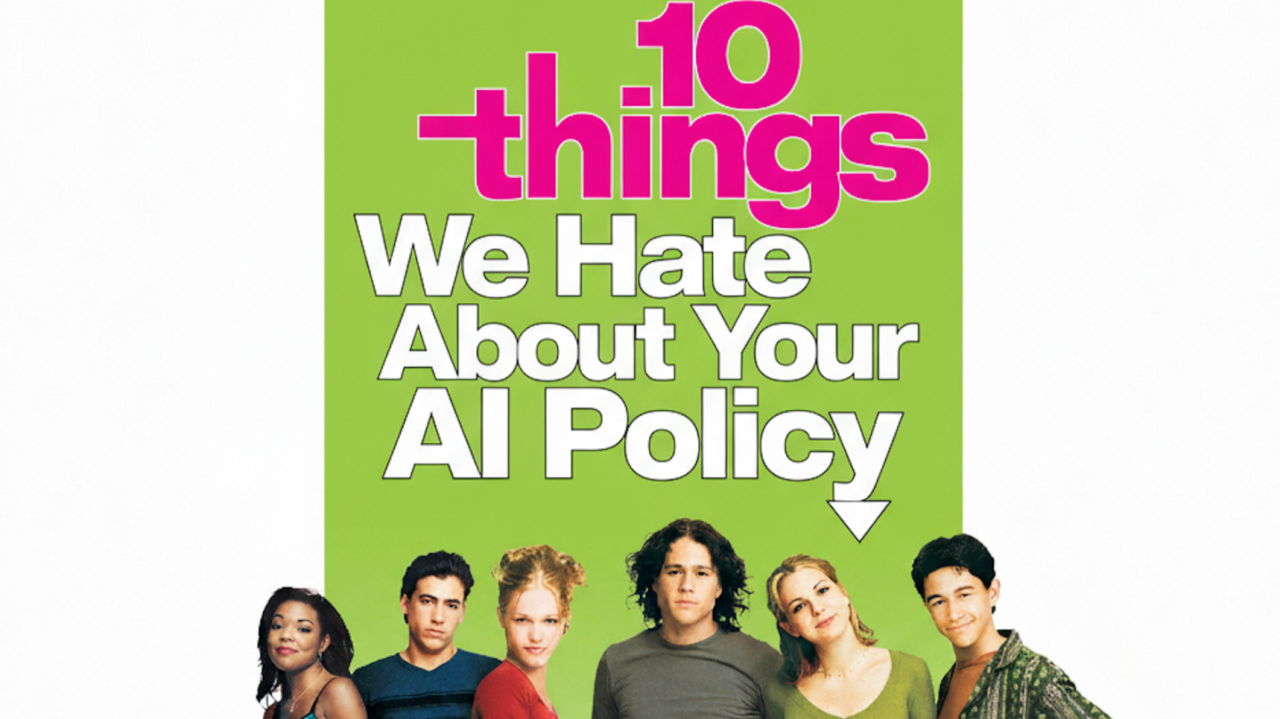
I have been playing with, tossing around, discussing with people who are interested (and people who aren't) about this concept that Brand/Governance are two sides of the same coin. Re: AI, I have said, "we need to make governance sexy" (for the shock value really) only to see buttoned up executives nod and easy going creatives say, 'for sure.' But to really drive this AI strategy home I think I need to invoke the power of late 90's cinema.
"we need to make governance sexy"
The Strange Chemistry Between Brand and Governance
So, in 10 Things I Hate About You, the classic American coming of age movie, there are two sisters who couldn’t be more different. Bianca, all charm and light. She's popular, seemingly sweet and the object of everyone's admiration. Her sister Kat, has sharp edges and unfiltered honesty. One moves through the world easily, she is loved, sought after, picture-perfect. The other is hard, crushes dreams, and refuses to smile on cue.
Every organization has these sisters. Bianca is the brand. Kat is the governance.
Brand is the one everyone wants to talk about, the magnetic promise, the image, the polish, the feeling that pulls people closer. Governance is the one everyone avoids, the rules, the caution, the part that shows up uninvited with a checklist. One is seen as inspiration. The other, obligation.
We need both Bianca and Kat. We need a powerful, attractive, alluring brand. But we need to put her to work! (Shout out Jonny Hawton for this idea). And AI showed us real fast that we need governance, guardrails, responsible use policies, mandated trainings.
To make AI work we need both... but the sisters also need each other (as Kat and Bianca teach us later).
Why Creativity Can’t Go Anywhere Until Governance Does
When the movie begins, their father has set a new rule in place: Bianca can’t do anything until Kat does. She can’t go out, can’t have her story move forward, can’t experience the part she wants to play until her sister, difficult, brilliant, principled Kat goes first. That’s where we are with AI. Our creativity, our innovation, our ambition and our people can only go as far as our governance allows them to be trusted. Kat needs to go with Bianca to the party. (Ughhhhhh).
When I look at how companies are using AI today, I see a lot of Biancas. Gorgeous brand campaigns about “human and machine collaboration.” Purpose statements about creativity, empowerment, inclusion. It all looks perfect on the surface. Like someone you really, really, really want to take to prom but don't know very well. But behind the curtain, Kat, the process, the ethics, the rules of engagement is treated like a wet blanket on innovation. When in fact, Kat is also gorgeous and someone you want to take to prom.
We’re comfortable talking about AI in brand language. We talk about innovation, speed, transformation. But we are uncomfortable building the systems that give those words weight, impact and accessibility for our people. Governance isn’t the fun part (but also, define fun?). Governance is the quiet force that makes clarity look effortless, and clarity is what makes everything beautiful. Governance, as my sister Elizabeth F. Lovato would say, "has really beautiful skin and doesn't need to paint her face up."
Plot Twist: Governance Is Gorgeous
AI exposes the gap between what you say and what you do. You can’t claim to be the brand that “champions empathy” if your generative models produce biased outputs or you shut your people out from tools all together. You can’t promise “transparency” while your AI policies sit unread on an internal site no one can find and shadow AI runs rampant. You can’t sell a story of “innovation” if employees don’t know where experimentation ends and risk begins.
That’s the plot twist of this era that 10 Things already taught us. Both sisters are gorgeous and your dream prom date. Meaning (phew this one could fire some folks up), governance is brand. And brand is governance. AI needs organizational leadership to sit them down on the couch and tell them that if they want to go to the party, they go together.
Look. I am a brand girl. Do not get me wrong. I never thought I would be advocating for governance. ME? Ms. Don't-Manage-Me-Jessica? No. But. fine. If this wild modern business philosophy and late 90's movie metaphor is not convincing you that governance is sexy and brand needs her...
Here are some stats... according to Forrester ’s 2025 report Ground Your Workforce AI Strategy in Human Experience, 30% to 60% of employees with AI licenses don’t use their tools often enough to justify the investment. Because they don’t understand the value, or they don’t trust the system. That’s not a technology failure, it’s a governance and brand failure. It's human.
The same report found that 77% of US workers don’t trust businesses to use AI responsibly. That’s a trust gap only brand can close and only governance can sustain. That is a job for Kat AND Bianca. This is not about compliance language. That is 10 Things I Hate About You language, that is cultural language. It’s about designing systems where people know how to behave, feel safe experimenting, and understand what the organization stands for.
Think about it (if you are't already): brand is how your employees understand what’s worth doing. Governance is how they understand what’s worth protecting. Both live or die by clarity, empathy, and credibility.
When governance is human-centered—when it shows up in the form of lived rituals, open conversations, visible guidance, it doesn’t suffocate creativity. It shapes it. It gives people permission to experiment safely. It creates belonging, not bureaucracy.
When governance shows up like brand, everyone likes her.
The Moral of the Movie (that you can take right to the Board Room)
NO SPOILERS. By the end of 10 Things I Hate About You, the sisters change each other. Bianca learns depth (ugh). Kat learns connection (charmed). They stop performing opposition and start practicing balance (brand/governance).
That’s what we need in organizations right now. We have to make governance as visible, as creative, and as emotionally intelligent as brand. And we have to make brand as accountable, as functional, and as lived as governance.
AI will not let us separate them. Every decision, from how we train models, where we deploy them, how we measure value, reveals the truth of who we are.
The brands that will thrive aren’t the ones with the loudest stories. They’re the ones with the clearest conscience.
So yes, it’s time to make governance sexy. Not with slogans, but with systems that feel as intentional, human, and aspirational as the stories we tell. Because in the end, brand and governance aren’t two sisters fighting over freedom and control. They’re learning the same lesson we are: To make anything last, you need both.
Like and subscribe for more wild and totally outrageous ideas about people.